


Signia MaX hearing aid review
Signia MaX hearing aids; my first impressions as an audiologist
Signia has just launched MaX, its newest hearing aid platform. It has been designed with one of the biggest hearing challenges in mind: trying to follow a conversation when several people are speaking and there is lots of noise going on around you.
I recently attended the UK launch at the Concorde Conference Centre in Manchester and had the chance to listen to the hearing aids for myself.
The setting could hardly have been more challenging. We were inside an aircraft hangar, right next to Concorde, with music playing, lots of people talking and planes taking off outside throughout the event. So, definitely not a quiet laboratory! To be honest, this made it a really useful place to experience what the technology could do.
What is Signia MaX?
MaX stands for Multi-adaptive Xperience. The first hearing aid to use the new platform is the Signia Pure Charge&Go MaX, which is a rechargeable receiver-in-canal hearing aid.
The big talking point is something Signia calls Acoustic Intelligence. This uses four separate Deep Neural Networks, known as DNNs, to look at different parts of the listening environment at the same time.
A Deep Neural Network is a type of artificial intelligence that has been trained to recognise patterns. In this case, it is listening for patterns in speech, noise, the wider environment, and the hearing aid wearer’s own voice. The four DNNs focus on:
- Other people’s voices,
- the wearer’s own voice,
- the surrounding environment,
- and background noise.
Why do we need four DNN’s? Well, a busy listening environment is rarely as simple as separating “speech” from “noise”. There can be several voices, music, movement, and lots of other sounds all happening at once. Some of those sounds matter to the listener and some do not.
The aim of MaX is to work out the difference; what is important for us to listen to and what can remain as low background hubbub for our safety and/or to retain atmosphere.
How is Signia MaX different?
Hearing aids have been analysing sound and reducing background noise for many years. The difficulty is that simply making all background noise quieter does not necessarily make it easier to join in a conversation.
Imagine sitting in a busy restaurant. Someone is speaking in front of you, another person is talking from the side, and somebody else stands up while they are speaking. Meanwhile, there is music playing, cutlery clattering, and conversation coming from nearby tables. If a hearing aid concentrates too narrowly on the person directly in front of you, it might also reduce the voice of somebody else you actually want to hear.
Signia’s solution is to give four different DNNs their own jobs, but have them working together as a system. Imagine your car. You have an engine to give power, wheels so it can move, a gear box and clutch so it can move smoothly, and a break to stop for safety, not to mention a whole bunch of other stuff. If we just had an engine working on its own, we wouldn’t get very far; we need all those different systems working together seamslessly to get to where we need to go; that’s what the DNN’s are doing.
What are the four Signia MaX Deep Neural Networks?
- RealTime Conversation Enhancement AI
This is designed to find and enhance more than one conversation partner at a time. It should help when a conversation moves quickly between different people, or when somebody changes position while they are speaking. That is particularly relevant for family gatherings, meetings, and meals out, where people rarely sit completely still and take turns speaking perfectly!
- Own Voice Processing AI
One of the things we often hear from new hearing aid wearers is that their own voice sounds too loud, hollow, or simply not like them. Signia’s Own Voice Processing identifies when the wearer is speaking and treats their voice separately. With MaX, it is designed to recognise the wearer’s voice automatically, without the voice-training process used with some earlier Signia hearing aids. To be honest with you, this was one of the most impressive features for me, despite blocking my ears up, I didn’t feel like my voice was booming in my head, in fact, I didn’t even notice it.
- Ambient Scene Adaptation AI
This part of the system looks at the wider environment and adjusts the hearing aids as things change. The aim is not to remove the whole atmosphere of a place. It is to keep the surroundings sounding natural while still helping the wearer access the voices they want to hear.
- Dynamic Noise Control AI
This looks at what type of noise is present, where it is coming from, and whether the wearer is involved in a conversation. The hearing aids can then decide how much noise reduction to apply, rather than treating every background sound in exactly the same way.

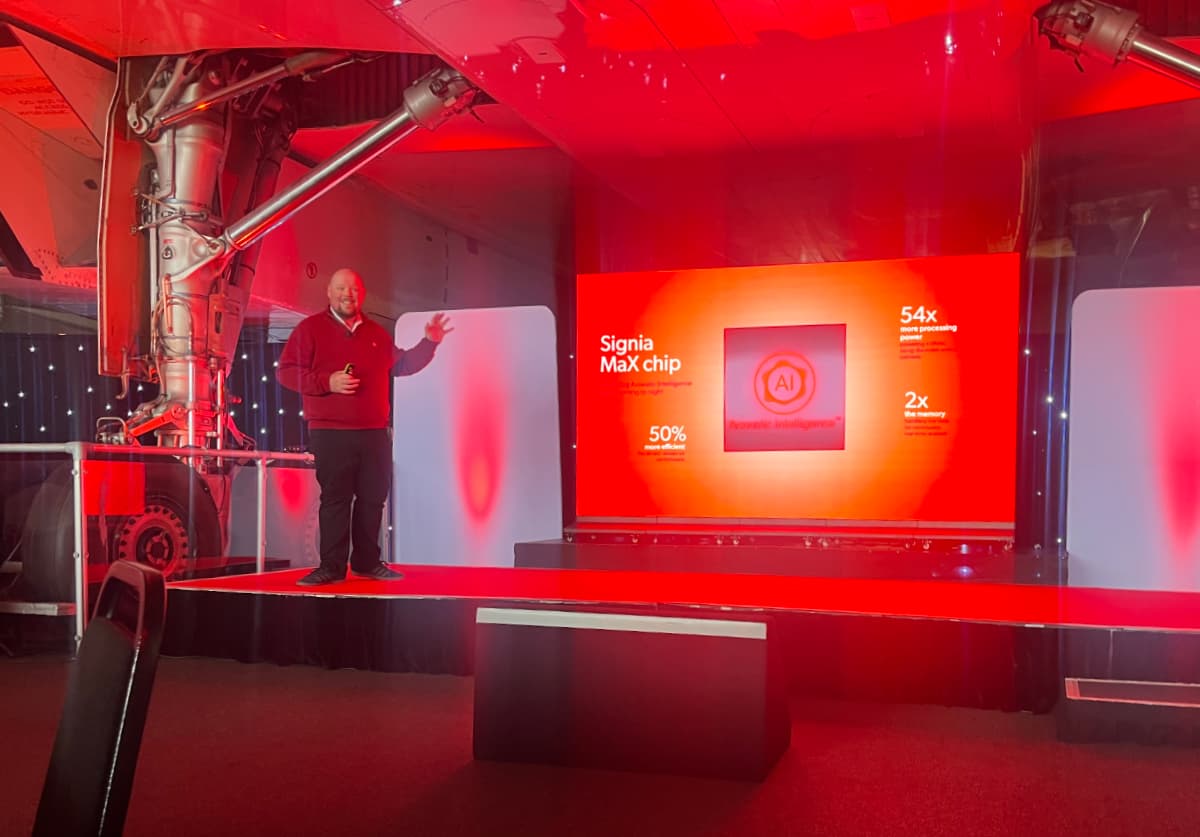
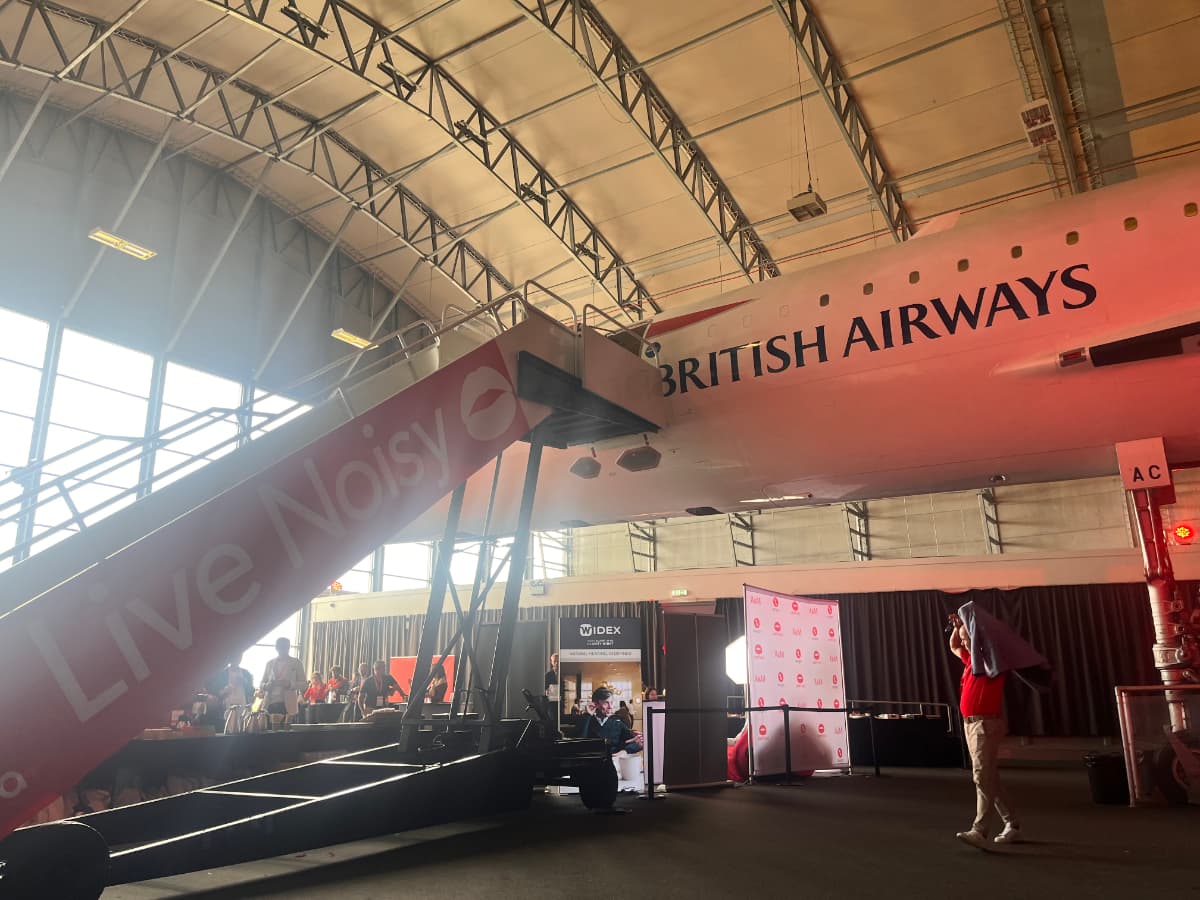
The Signia MaX hearing aid launch in Manchester.
What happened when I tried Signia MaX?
The launch gave me the opportunity to listen to the hearing aids in what was, to be honest, an incredibly difficult environment – the Concorde Conference Centre in Manchester. There was music, lots of conversation, reverberation from the aircraft hangar, and the regular sound of planes taking off outside.
I have normal hearing, so I needed to temporarily block, or occlude, my ears to properly hear what was coming through the hearing aids. Otherwise, natural sound would have leaked around them and mixed with the sound being processed.
By blocking my ears, I could hear the technology working much more fully, with no other sound leaking in. A lady was speaking very softly and I could hear her clearly, despite everything going on around us. I could also easily follow a man who was standing and speaking whilst I was sitting down. That difference in position and height could have made him more difficult to hear, but it really didn’t.
What struck me was that the hearing aids did not simply make the whole environment quiet. I could hear them separating the different parts of the soundscape and making speech accessible without completely removing the atmosphere around me; it was honestly impressive.
However, I do need to add some context. This was my personal experience at a product launch, not a formal clinical trial. It does not mean every wearer will have exactly the same result.
Hearing loss, ear shape, how someone’s brain responds to new sounds coming in, the fitting and programming of the hearing aids, and the listening environment itself, will all affect how somebody hears with them.
What does Signia say about hearing in background noise?
According to Signia’s launch information, 97% of the people who took part in its research performed better with MaX in noisy group conversations than they did with selected competing hearing aids; that is certainly encouraging.
However, it is important to be clear that these results come from Signia-sponsored research. They are not yet part of a large body of independent, peer-reviewed evidence.
Signia MaX is very new, so we will learn much more as independent testing is carried out and more people begin wearing the hearing aids in everyday life.
Connectivity, charging, & everyday features
The Pure Charge&Go MaX brings together several connectivity options in one rechargeable hearing aid. These include:
- Bluetooth Classic
- Bluetooth LE Audio
- A telecoil for compatible hearing-loop systems
- Hardware designed to support Auracast
- Connectivity with compatible Apple and Android devices
I am pleased to see a telecoil included. Hearing loops are still really useful in theatres, places of worship, meeting rooms, and many public buildings.
The hearing aids also contain the hardware needed for Auracast. However, full Auracast functionality is not active at launch. Signia says it expects to enable this through a firmware update by March 2027. So, if Auracast is one of your main reasons for considering MaX, it is worth knowing that the feature is planned but not currently available.
The hearing aids come with a portable charging case that can store up to four additional full charges. Signia says that a full charge takes approximately four hours, while a quick 30-minute charge can provide up to six hours of use.
As with all rechargeable hearing aids, the actual battery life will depend on how they are programmed and how much streaming you do.
What are the potential benefits of Signia MaX?
From the information available and my experience at the launch, the most interesting potential benefits are:
- Better access to several speakers during a group conversation
- More selective control of background noise
- Automatic processing of the wearer’s own voice
- Continuous adjustment as the environment changes
- Rechargeable operation with portable charging
- Several connectivity options in one hearing aid
- Telecoil support for hearing loops
I think the technology will be particularly interesting for people who struggle in restaurants, meetings, family gatherings or other places where several people may be speaking.
What are the limitations of Signia MaX?
Signia MaX is new, and being impartial means looking at the limitations as well as the exciting bits.
At launch, the platform is available as a rechargeable receiver-in-canal hearing aid. It may therefore not be suitable for somebody who needs a custom in-the-ear hearing aid, a more powerful behind-the-ear model, or a CROS system.
There is also less independent evidence and long-term wearer feedback available for Signia MaX than there is for more established hearing aids.
Some of the advertised improvements are comparisons with Signia’s previous IX platform, and the main performance figures currently come from manufacturer-sponsored studies.
Most importantly, the newest hearing aid is not automatically the best hearing aid for every person.
A carefully chosen and properly programmed hearing aid can perform better than an expensive premium product that has not been fitted well. The technology matters, of course, but so do the assessment, fitting, verification, follow-up care, and the skill of the audiologist.
If you already have hearing aids that are comfortable, properly fitted and working well, you do not necessarily need to replace them simply because MaX has arrived.
Who might benefit from Signia MaX?
MaX may be worth exploring if you:
- Find group conversations particularly difficult
- Regularly spend time in busy social or professional environments
- Want a rechargeable receiver-in-canal hearing aid
- Use hearing loops
- Want to stream calls or audio from compatible devices
- Have previously disliked the sound of your own voice through hearing aids
That does not mean it will automatically be the right choice.
We would still need to consider your hearing test results, ear health, dexterity, lifestyle, listening priorities, and preferred hearing aid style before making a recommendation.
Why the fitting still matters as much as the technology
No hearing aid can restore completely normal hearing or remove every single unwanted sound, and even the cleverest technology needs to be selected and programmed properly.
A comprehensive hearing assessment tells us about the type and level of hearing loss, but it is also important to understand where somebody is struggling; is it at home? In meetings? In restaurants? At the theatre? Or when the whole family gets together? The answers help us choose and programme hearing aids around the person, rather than simply choosing a product because it is new.
Follow-up care is equally important. Real-world listening often shows us where further adjustments would be helpful, particularly in complicated situations involving background noise and several speakers.
My honest first impression of Signia MaX
My first experience of Signia MaX was very positive. The aircraft hangar gave the hearing aids a lot to deal with: music, reverberation, multiple speakers, and planes taking off outside.
Even with all of that hustle and bustle, I could hear a softly spoken lady and a man speaking from a different position and height with surprising ease. The thing I noticed most was how the hearing aids appeared to separate speech from the competing sounds around it. They did not simply make everything louder and they did not try to make the whole environment silent; that, I think, is the most interesting part of the new technology.
However, these are still my first impressions from a launch event. We need independent evidence and, importantly, feedback from people wearing Signia MaX in their own everyday environments.
For some people, particularly those who find busy group conversations difficult, Signia MaX could prove to be a really meaningful step forward. For others, a different hearing aid style, technology level, or manufacturer may be more suitable.
If you would like to find out whether Signia MaX hearing aids could be right for your hearing and lifestyle, Cardiff Hearing can provide a full hearing assessment and honest, impartial advice about all of the available options.
Watch Signia audiologists explain Signia MaX with Acoustic Intelligence
Watch Signia audiologists explain Signia MaX with Acoustic Intelligence.
By Sonja Jones
Senior Audiologist
If you would like to find out whether Signia MaX hearing aids could be right for your hearing and lifestyle, then why not book a personalised hearing needs assessment, or get in touch to discuss your requirements with one of our audiologists, without obligation.